
Namaz Times · India
Namaz Times in Delhi, India Today
Delhi prayer times today cover Fajr through Isha for India's capital and seat of government. This page uses the University of Islamic Sciences, Karachi method (Fajr 18°, Isha 18°) and the Asia/Kolkata timezone (IST, UTC+5:30), with updates for Old Delhi, Nizamuddin, and Lutyens Delhi — plus a monthly calendar and Qibla direction.
Next prayer
Isha · 19:38
Today's prayer times
- Fajr 04:50
- Sunrise 06:09
- Dhuhr 12:14
- Asr 15:43
- Maghrib 18:19
- Isha 19:38
Calculation method: University of Islamic Sciences, Karachi
Twenty-one minutes west of the clock
Delhi sits at roughly 28.61 degrees north and 77.21 degrees east. Indian Standard Time is drawn from the meridian at 82.5 degrees east, which runs well to Delhi's east, through eastern Uttar Pradesh. A degree of longitude is worth four minutes of solar time, and the capital lies a little over five degrees west of that reference line. The sun therefore reaches its highest point over Delhi about twenty-one minutes after the clock has said noon.
That offset is fixed, it applies to all five prayers equally, and it is the single most useful thing to understand about namaz time in this city. Dhuhr is late against the clock here because the clock belongs to a meridian several hundred kilometres away, not because anything unusual is happening in the sky over Delhi.
The same arithmetic explains the gap between Delhi and the east of the country. Kolkata is about eleven degrees further east, which is roughly forty-five minutes. Maghrib there has already passed while Delhi is still waiting for it, every evening, on the same national clock. A timetable carried from one city to the other is not slightly off; it is three quarters of an hour wrong.
Which Asr this page publishes
Asr is the one prayer where the disagreement is legal rather than astronomical, and in a Hanafi-majority country it is what people actually search for. Both positions start from the same measurement: the shadow an object casts at solar noon, which at Delhi's latitude is never zero. From that baseline:
- The Shafi'i, Maliki and Hanbali position holds that Asr begins when the shadow has grown by one further length of the object itself.
- The Hanafi position waits until the shadow has grown by two further lengths.
The Hanafi time is always the later of the two, commonly by forty minutes to an hour, and the gap widens in the winter months when the sun stays low. The times published here use the Hanafi threshold, which is what the great majority of Delhi's mosques follow. If you come from a Shafi'i background, take Asr from the mosque you pray in rather than from this table — neither is a miscalculation.
The Karachi parameters, applied to the capital's coordinates
Fajr and Isha have no shadow to measure. They are fixed by how far the sun has fallen below the horizon, and that angle is a matter of scholarly convention. This page uses the University of Islamic Sciences, Karachi standard — eighteen degrees for dawn and eighteen degrees for nightfall — which is the convention in general use across the subcontinent. The background is set out on the India prayer times hub.
If an app shows a Fajr several minutes away from what the local masjid announces, the calculation method is the first thing to check. A default left on Muslim World League or a Gulf convention uses a different dawn angle and will drift. Once the method matches, any residue is almost always iqama practice: the interval a mosque leaves between the adhan and the congregation is a local decision, and in a city with as many mosques as Delhi it is nowhere near uniform.
What 28.6 degrees north does across the year
Delhi is far enough north for the seasons to be felt in the timetable. Across a full year the dawn travels something in the order of an hour and a half between its earliest point near the summer solstice and its latest in winter, with Maghrib covering a comparable distance in the opposite direction. A routine fixed in January feels distinctly wrong by June.
None of that movement comes from the clock. India keeps UTC+5:30 in every month with no daylight saving, so everything shifting in the table is the sun. The half-hour offset is itself unusual — most of the world runs on whole hours — and it follows from setting national time by that 82.5 degree meridian.
Roza, sehri and iftar on a Delhi timetable
The fast is bounded by Fajr at one end and Maghrib at the other. Sunrise appears in the table but marks neither; it closes the window in which Fajr can still be prayed. Treating sunrise as the end of sehri is a recurring and expensive mistake, because an eighteen-degree dawn angle leaves a substantial interval between Fajr and the sun appearing.
Because Isha is set by a twilight angle rather than a fixed interval after sunset, the space between iftar and taraweeh is not the same in every season, and not quite the same on the last night of Ramzan as on the first. Look at the monthly Delhi table once at the start of the month rather than assuming the opening day's figures will hold for thirty.
Friday prayer in Delhi
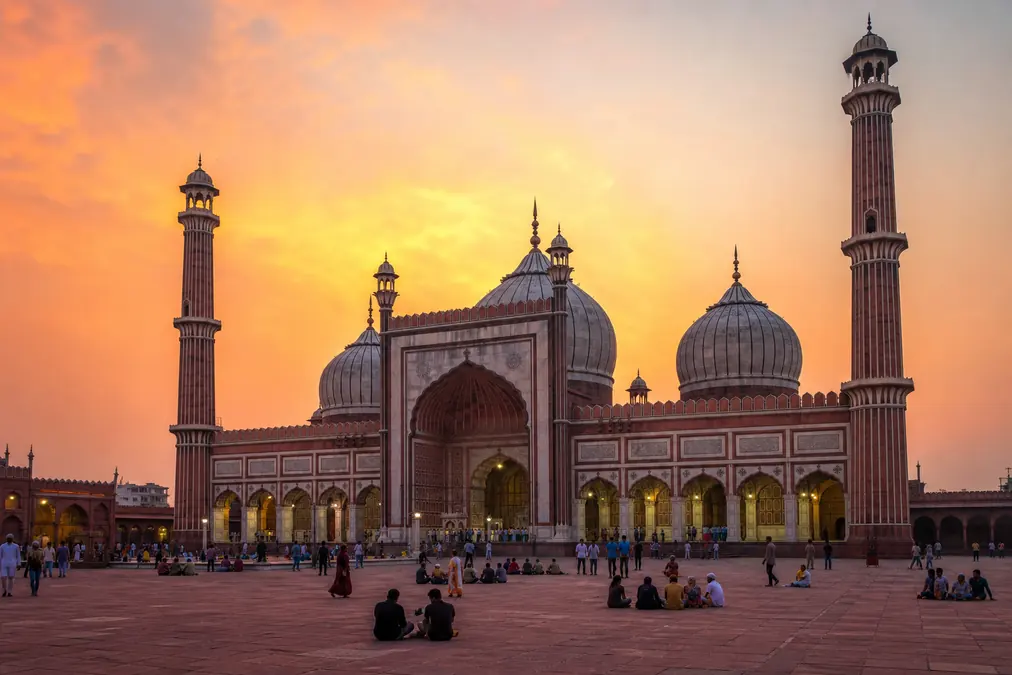
Jumu'ah replaces Dhuhr for those attending. The call is anchored to the Dhuhr time shown here, but the khutbah's start and length belong to the imam, and the large congregations — Jama Masjid in the old city among them — fill well before the adhan goes out. That is why many people leave earlier than the timetable alone would suggest. Anyone praying at home prays Dhuhr at its ordinary listed time.
Finding the Qibla, and where to go next
Use the Qibla direction tool to resolve the bearing from your own coordinates rather than working from a figure someone quoted for another city. From anywhere in India the direction is broadly westward, but the precise bearing changes across the country and a phone compass indoors is easily pulled off by steel and reinforced concrete. For Ramzan and Eid dates, see the Hijri calendar. The nearest comparisons on this site are Jaipur prayer times, about six minutes later than here, and Lucknow prayer times, about fifteen minutes earlier.
Frequently asked questions
What time is Fajr prayer in Delhi today?
Fajr prayer time in Delhi today is 04:50, calculated using University of Islamic Sciences, Karachi.
What time is Maghrib in Delhi today?
Maghrib prayer time in Delhi today is 18:19.
What time is Isha in Delhi today?
Isha prayer time in Delhi today is 19:38.
Which calculation method is used for Delhi prayer times?
We use University of Islamic Sciences, Karachi for this city — the local standard for accurate adhan times.
Why is Asr at my mosque in Delhi later than the time shown?
Almost certainly because your mosque follows the Hanafi position, which predominates here. Hanafi reckoning begins Asr when an object's shadow reaches twice its own length plus the noon shadow. The Shafi'i, Maliki and Hanbali position begins when the shadow equals the object's length, roughly forty to sixty minutes earlier. Both are established positions; neither is an error.
Are Friday (Jumu'ah) times different in Delhi?
On Fridays, Jumu'ah replaces Dhuhr for those attending the mosque. The adhan is called at around the Dhuhr time shown here, but the khutbah and iqamah schedule is set by each mosque individually, so check with the one you attend.
Nearby cities in India
Distance and direction from Delhi. Cities to the east reach Maghrib earlier; cities to the west reach it later.