
Prayer Times · Tunisia
Prayer Times in Tunis, Tunisia Today
Tunis prayer times today for Tunisia's capital and largest city, from the medina and Zitouna Mosque to Carthage, La Goulette, and the Lac district. Calculated with the Tunisia method (Ministry of Religious Affairs, Fajr 18°, Isha 18°) and the Africa/Tunis timezone (UTC+1), with monthly schedules and Qibla direction.
Next prayer
Asr · 15:40
Today's prayer times
- Fajr 04:39
- Sunrise 06:06
- Dhuhr 12:12
- Asr 15:40
- Maghrib 18:18
- Isha 19:45
Calculation method: Tunisian Ministry of Religious Affairs
Where the capital sits
Tunis occupies the head of its gulf on the north-eastern coast, near 36.81 degrees north and 10.18 degrees east. The table above is computed from that position for today's date and refreshed daily. It reports when each prayer's time enters — an astronomical quantity — and not when any particular congregation stands up, which is a separate and locally decided matter.
Why the clock runs behind the sun in Tunisia
This is the single most distinctive thing about Tunisian prayer times, and it puzzles visitors more than anything else on the page.
Tunisia keeps UTC+1, a zone whose reference meridian lies at fifteen degrees east. The capital sits almost five degrees west of that line. Because the sun takes roughly four minutes to travel each degree, solar events here happen close to twenty minutes later on the clock than they would in a place sitting directly on the zone's meridian. Midday by the sun is not midday by the clock; it lands appreciably after it.
Everything in the table inherits this. Dhuhr in particular falls later in the afternoon than newcomers expect, and it is not an error, a rounding artefact or a peculiarity of the method. It is the ordinary consequence of a country keeping a clock set for a meridian to its east. Every Tunisian city is affected, the western ones slightly more than the eastern.
The Zitouna and the national timetable
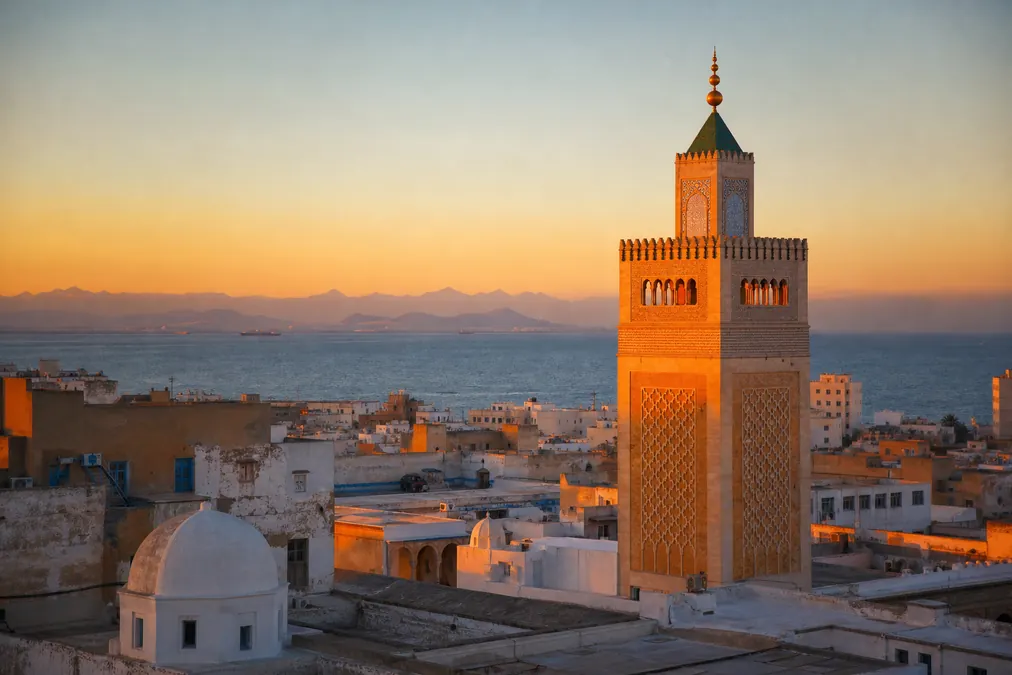
The Zitouna Mosque in the medina is among the oldest and most significant institutions of learning in North Africa, and Tunis has been a centre of Maliki scholarship for a very long time. The timetable in force today, however, is administrative rather than scholarly in origin: the Ministry of Religious Affairs publishes one set of parameters, applied nationally, and calculation libraries carry them as method 18.
Both twilight angles are set to eighteen degrees — dawn and nightfall use the same figure, which is not true of every method. The Tunisia prayer times hub goes into the background. What matters locally is that mosques across the capital work from that single national standard, so differences you notice between them are not differences of calculation.
Asr in a Maliki country
Tunisia is Maliki, and the Asr threshold reflects it. Take something standing upright: its shadow is shortest at midday, and Asr opens once that shadow has grown past the minimum by the height of the object itself. Shafi'i and Hanbali jurists agree; the Hanafi school requires the shadow to lengthen twice as far and therefore prays later in the afternoon. Since Tunisian practice is essentially uniform on this point, the figure here should match what is posted throughout the capital.
What the year does at nearly thirty-seven degrees north
Tunis lies further from the equator than most cities covered on this site, and the seasonal spread is correspondingly wider. Summer days are long, winter days noticeably short, and Fajr and Maghrib travel a considerable distance between the solstices. Dhuhr moves comparatively little.
None of that movement is complicated by clock changes. Tunisia does not operate summer time, so the offset stays at UTC+1 in every month and the table shows solar motion undisguised. A routine built around the prayers in one season will need genuine adjustment in another.
Friday at the Zitouna and the neighbourhood jawami'
Friday's congregational prayer replaces Dhuhr for those attending and is timed from the Dhuhr entry above. In a city with as many mosques as this one, the interval each keeps between the call and the start of prayer varies considerably, as does sermon length. Anyone not attending owes Dhuhr at its listed time in the usual way.
Ramadan between the medina and the suburbs
Fajr closes the pre-dawn meal and the fast is broken at Maghrib. Both boundaries move steadily across the month, and at this latitude they move more than they would further south — a Ramadan falling in summer lengthens noticeably as it progresses.
Sunrise appears in the table as well and marks neither boundary. Its function is to close the window in which Fajr may still be prayed. Because both of Tunisia's twilight angles are set at eighteen degrees, Fajr sits well ahead of first light, so the interval between the two rows is substantial rather than trivial.
The table against the loudspeaker
People frequently find that a mosque begins several minutes after the time shown here and conclude one of the two is wrong. Usually neither is. Congregations set an iqama delay so worshippers can arrive, and that delay is theirs to choose. The other common cause of disagreement is an application left on an imported default rather than the Tunisian standard, which will shift Fajr and Isha by a few minutes in one direction or the other.
Facing the Kaaba from the capital
Use the Qibla direction tool to obtain the facing from your own position rather than working from a direction someone has quoted you. For Ramadan and Eid dates alongside this table, see the Hijri calendar; there is also an Arabic Tunis schedule. The immediate northern suburb is covered by Ariana prayer times, and Bizerte prayer times handle the north coast.
Frequently asked questions
What time is Fajr prayer in Tunis today?
Fajr prayer time in Tunis today is 04:39, calculated using Tunisian Ministry of Religious Affairs.
What time is Maghrib in Tunis today?
Maghrib prayer time in Tunis today is 18:18.
What time is Isha in Tunis today?
Isha prayer time in Tunis today is 19:45.
Which calculation method is used for Tunis prayer times?
We use Tunisian Ministry of Religious Affairs for this city — the local standard for accurate adhan times.
Are Friday (Jumu'ah) times different in Tunis?
On Fridays, Jumu'ah replaces Dhuhr for those attending the mosque. The adhan is called at around the Dhuhr time shown here, but the khutbah and iqamah schedule is set by each mosque individually, so check with the one you attend.
Nearby cities in Tunisia
Distance and direction from Tunis. Cities to the east reach Maghrib earlier; cities to the west reach it later.